
EXPERIENCE REPORT TRIFOKALLINSEN ISTANBUL Türkiye – Report from Friday, April 6, 2018
Anytime again! – Report and chronology of the trifocal lens exchange in Istanbul
I am writing this very detailed report about lens replacement surgery (similar to glaucoma surgery) so that those interested can get a clear picture of the procedure and timeframe for such an operation, in addition to the quality of SwissLasik and the Acibadem Maslak Hospital. Previous reports gave the impression that lens replacement could be done quickly and easily.
About me:
I am female and turned 57 in the spring of 2018. My eyes have always been perfectly healthy (i.e., no cataracts). I got my first glasses at the age of 11. At that time, they corrected my nearsightedness of -2.5 diopters in both eyes. Over the years, my nearsightedness steadily increased, eventually reaching -9.5 and -9.75 diopters. In addition, I developed astigmatism of -0.75 and -1.0 diopters, as well as presbyopia, which is now +2.5 diopters in both eyes.
September/October 2017:
After reading on the internet that it is now possible to correct refractive errors of up to -12 diopters with laser surgery, I first inquired about laser options at two different laser companies in Zurich.
Both providers were fully aware of my vision problems before the initial free consultation. I didn’t trust the first provider because of how the conversation went, as he wasn’t a doctor and, firstly, suggested an outdated laser treatment without discussing any alternatives. With the second provider, I was examined and consulted directly by the surgeon who would potentially perform the procedure, free of charge. He advised against laser treatment but explained the possibility of lens implantation with phakic lenses. This surgery would have been performed by this doctor himself in Vienna, at a price of €8,000, plus flights and accommodation in Vienna. I trusted him, but the price was very high.
In the meantime, colleagues had drawn my attention to Turkey and told me about the experiences their family members had there. So I did some more research online and discovered that Turkey is indeed a leader in eye treatments, boasting top doctors and hospitals equipped with state-of-the-art technology. Many foreigners travel to Turkey specifically for eye surgery. I had never been to Turkey before, not even for a holiday.
That’s how I eventually came across SwissLasik, Medical Travel GmbH, Länggasstrasse 8, 3012 Bern. Their website is very comprehensive and answered many of my questions. There are other providers of medical tourism in Switzerland, but they don’t offer such a wide range of services as SwissLasik. Furthermore, based on my research so far, SwissLasik is the only provider that offers follow-up treatment in Switzerland with its premium package. SwissLasik also seemed very reputable to me because of its many years of experience and the press releases I read.
October 25, 2017:
So I sent an email to SwissLasik with my last glasses prescription from 2015, a photo of the lens packaging, a suitability questionnaire, and over 20 questions about laser eye surgery in Istanbul. I immediately received a spam email from SwissLasik. That wasn’t what I expected…
October 26, 2017:
That’s why I called SwissLasik. The managing director of SwissLasik, Serdar Karaagaçli (hereafter referred to as Mr. Kara), explained to me over the phone that the first email would be sent automatically, but that he was currently working on answering my extensive list of questions. Fifteen minutes later, I received his answers, and I was impressed by how thoroughly he had addressed each and every one of my questions. Even at that early stage, I could sense his dedication and his genuine enjoyment of what he does.
Furthermore, due to my severe visual impairment, he suggested I have a thorough preliminary examination with one of his referring physicians in the canton of Zurich, so that I wouldn’t travel to Istanbul unnecessarily. Although Mr. Kara has a referral practice in the city of Zurich, only a 15-minute walk from my home, he recommended the quieter option outside the city for the examination, which was wise advice. He even had a suggested appointment time.
2. November 2017:
A comprehensive preliminary examination was conducted by an ophthalmologist in the Canton of Zurich. This assessed my basic suitability for laser eye surgery, lens implantation, or lens replacement. However, this doctor was not responsible for making recommendations regarding which treatment I should undergo. As Mr. Kara had indicated, the cost of this examination was CHF 275, payable in cash at the doctor’s office. I received a receipt. The examination was successful, and I was able to consider my next steps. The doctor sent the examination results to SwissLasik on the same day. SwissLasik then forwarded the results to the Acibadem Maslak Hospital in Istanbul for evaluation by ophthalmologist Prof. Dr. Banu Coşar. I also received the examination results from the Swiss ophthalmologist via email from SwissLasik.
3. November 2017:
In the meantime, I abandoned the idea of laser surgery and was leaning towards phakic lens implantation. In my mind’s eye, I was already flying to Istanbul a week before Christmas so I could use the Christmas holidays in Switzerland for the recovery process after the eye surgery. As a full-time employee, I didn’t want to sacrifice my vacation time for convalescence. After all, you can’t get a sick note from your employer for voluntary eye surgery. But Mr. Kara, with his refreshing, discreet, and diplomatic manner, brought me back down to earth. He did suggest a travel date of December 18th to 22nd, 2017, but pointed out that this timeframe was “almost impossible” in the case of lens surgery, because the lenses usually have to be pre-ordered. The evaluation of the Swiss examination results by the clinic in Istanbul takes an average of about seven business days.
14. November 2017:
Email from SwissLasik: The surgeon in Istanbul also advised me against laser surgery and, contrary to my wishes and due to my age, recommended multifocal or trifocal lenses. Phakic lenses were also an option, of course. Both lens options would cost €4,400. Naturally, I had many questions for Mr. Kara, which he answered immediately and thoroughly.
In any case, I had to have my eyes measured using the IOL Master system at his referral practice in Zurich-Oerlikon. Mr. Kara pointed out that it was a large ophthalmology practice and that scheduling appointments and contacting them by phone could be somewhat cumbersome. He could, however, handle this for me. Since I had been a patient at this practice before, I managed to schedule an appointment myself, albeit after several attempts.
December 1, 2017:
IOL Master measurement (for ZEISS lenses) in Zurich-Oerlikon. The measurement is not performed by a doctor, takes a maximum of 3 minutes, requires no drops, etc., and costs CHF 175.-. This amount is also payable in cash at the practice. Those who wish to have a consultation with a doctor after the measurement pay a total of CHF 250.-. According to SwissLasik, however, only the measurement was necessary. The results of the IOL Master measurement were sent to SwissLasik and to me by email on the same day. In the meantime, I bombarded SwissLasik again with my questions regarding lens and surgical options via email, and the answers followed promptly.
December 11, 2017:
All documents, including the IOL Master measurement, were assessed in Istanbul by Prof. Dr. Banu Coşar regarding the possibilities and my wishes.
Ultimately, I had to choose a lens option. As recommended, I opted for trifocal lens surgery with a femtosecond laser incision. The femtosecond laser incision costs extra, as stated on the SwissLasik website. The lenses should correct distance (nearsightedness), intermediate (computer work), and near vision (presbyopia), as well as astigmatism. Production of these lenses took a little longer due to the Christmas holidays in Germany.
SwissLasik again informed me of the estimated costs for these custom-made lenses and the payment terms. I gave my consent via email and immediately received a quote with the anticipated travel date by email. I accepted the quote in advance, also by email.
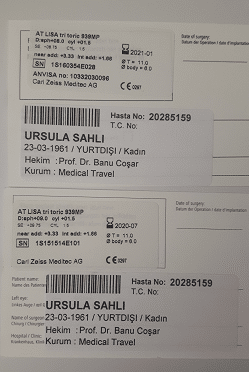
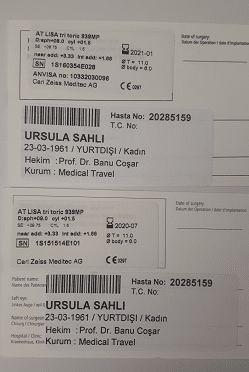
(My trifocal lenses, AT LISA tri toric 939MP, which were waiting for me at the Acibadem hospital.)
December 13, 2017:
I received all the documents by mail from SwissLasik, including all the final bookings for February 18th to 23rd, 2018, as well as two invoices totaling CHF 6,490 for the premium package (toric trifocal lenses, surgery with femtosecond laser incision, all transfers from airport to hotel to clinic to hotel, etc., and back to the airport, flight with Turkish Airlines, five nights at the Levent Hotel, and four follow-up examinations in Switzerland within one year with the same doctor who had conducted the initial, comprehensive examination). The SwissLasik passport documented the entire process of my stay, including the surgery date, flight booking, etc. While the Istanbul map is in German, it’s not very good. Google Maps or an offline city map app provides a better overview.
I had to sign a brokerage agreement and return it to SwissLasik, as well as make a down payment. Because of Mr. Kara’s professional, efficient, and competent approach, I paid the entire amount immediately. On the SwissLasik website, the premium package for this treatment is listed at CHF 5,857 for the lenses plus CHF 650 for the femtosecond laser incision. I therefore actually paid CHF 17 less. Mr. Kara assured me that he would continue to be available as a contact person, and this proved to be true, although it was hardly necessary anymore. And now began the waiting and hoping that I wouldn’t get sick or that anything else would happen to prevent the trip.
February 18, 2018:
I flew from Zurich with Turkish Airlines and landed in Istanbul at 11:20 p.m. Incidentally, Turkish Airlines is making great strides in quality and gaining ground. For the short flight time of just under three hours, they even serve a hot meal and drinks, something many airlines no longer offer or only for an extra charge. Thanks to the description in my SwissLasik Pass, I found the “Acibadem Health Point” immediately. They were already expecting me there and organized transport to the Levent Hotel. I was the only passenger in a 7-seater bus marked ACIBADEM and was driven to the Levent Hotel, arriving at approximately 1:00 a.m. (local time), where I was also expected. They made a photocopy of my ID card. There were no forms to fill out. My carry-on suitcase and I were taken to my room. Even as a solo traveler, I had a very large room with a double bed, a kettle, and other amenities. My Wi-Fi access didn’t work in my room on the first day, but this was quickly fixed.
The Levent Hotel is a 3-star hotel and was sufficient for my needs.
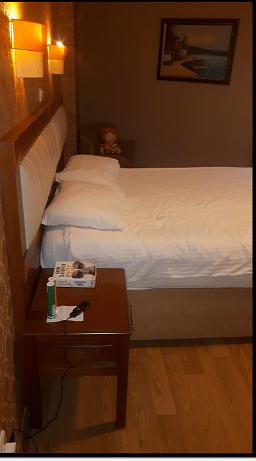
There was always someone at reception who spoke at least English and was happy to help. The breakfast buffet was varied, so all guests – including vegetarians – could find something delicious. Furthermore, the hotel is strategically well located. The M2 metro line (Levent station) is just a few minutes’ walk away, providing easy access across Istanbul. The M6 line to Etiler and the university also departs from there.
February 19, 2018:
According to my SwissLasik pass, I was supposed to be picked up at my hotel at 11:00 AM for a thorough eye examination at Acibadem Maslak Hospital. I was just sitting down to breakfast when I was informed at 8:30 AM that my driver had arrived. After a few quick checks, the driver showed me a list on which my name was indeed entered for 9:00 AM. So I left my breakfast, rushed back to my hotel room, brushed my teeth, gathered everything I needed (ID card, SwissLasik pass), and was driven to the clinic. All the transport vehicles (buses or cars) were clearly marked with the ACIBADEM logo. This reassured me as a solo traveler and also gave me confidence in the drivers. They were usually at my hotel 15 to 30 minutes before the scheduled pick-up time.
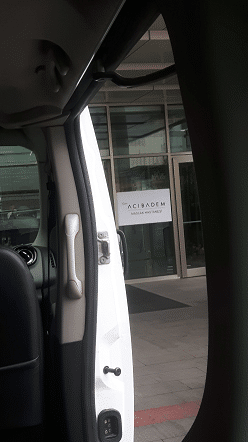
(View from the transport bus)
The first time I arrived at Acibadem Maslak Hospital, “my” German interpreter was already waiting for me. Incidentally, it was the same interpreter you see in the SwissLasik video about Denise Senn’s laser surgery. This interpreter has been working at Acibadem Maslak Hospital for nine years. His task for that day and the following days was to guide me through the hospital’s labyrinthine layout, handle the formalities with the staff, explain the forms I needed to sign (there were only a few), and translate the staff’s instructions and my replies.
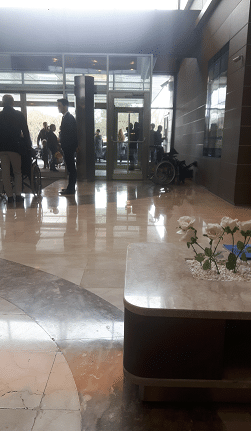
(Acibadem Maslak Hospital: Reception area and International area)
The examination process was much the same as in Switzerland, except that at Acibadem Maslak Hospital I received pupil-dilating drops for one of the tests. After the examinations, which had been performed by various staff members, were completed, I finally entered the consulting room of the “legendary” doctor, Prof. Dr. Banu Coşar. I had often doubted that I would actually be seen and operated on by this woman. After all, two months had passed since December 2017, and she might not have been available due to illness or other commitments. But no, it really was her! And when we decided that it would be easier to communicate in English, we dismissed the interpreter for these conversations. Prof. Dr. Banu Coşar performed some brief vision tests. She determined which of my eyes was stronger. She informed me about the side effects of lens replacement (10-20% of patients still require a small reading aid despite lens replacement; halo effect, etc.). She then informed me that the examinations had indicated that the eye surgery was possible. The surgeries were scheduled for one eye at a time, on Tuesday and Thursday at 3:00 PM.
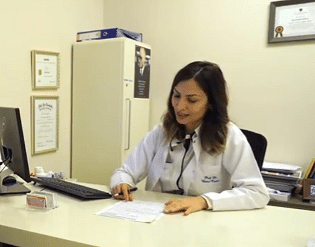
(In the office of Prof. Dr. Banu Coşar)
The interpreter was called to organize the transport to the hotel. He also gave me all the times for my pick-up from the hotel to the hospital for the remainder of my stay in Istanbul. All the transfers went smoothly and were usually even a little ahead of schedule.
I spent the rest of the day visiting the Metro City shopping mall and stocking up on water and food for the rest of the week at the Migros there, because I didn’t know how I would feel after the two surgeries. Too late, I read at the hotel that you’re not supposed to take food or drinks from your room. But nobody said anything. Perhaps that was because I was traveling alone.
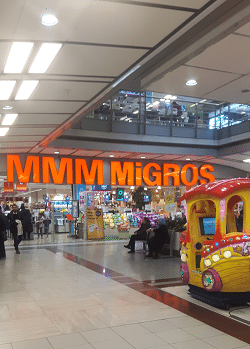
(MiGROS in the Metropol City shopping center)
At the metro station, I bought an Istanbulkart from a machine and loaded it with a considerable amount of credit so I wouldn’t have to worry about paying for public transport. The Istanbulkart is the cheapest way to get around Istanbul.
February 20, 2018:
From 8:30 a.m. onwards, I wasn’t allowed to eat anything, and from 9:30 a.m. onwards, I wasn’t allowed to drink anything. I was being picked up from the hotel at noon. To make the most of my time, I took the M2 metro from “Levent” to “Vezneciler” at 9:00 a.m. From there, you can easily reach all the major sights on foot. Incidentally, from the metro car, you have a beautiful view of the sea and the historic part of Istanbul before you reach the “Halić” station.
(View of the old town from the metro car (M2) in front of the “Halic” stop).
The Acibadem driver arrived at approximately 11:45 a.m. This time, there were already other people in the seven-seater. After arriving at Acibadem Maslak Hospital, I went down the escalator to the international patient area and checked in with the interpreters. My German interpreter then guided me to the area where the surgery would take place.
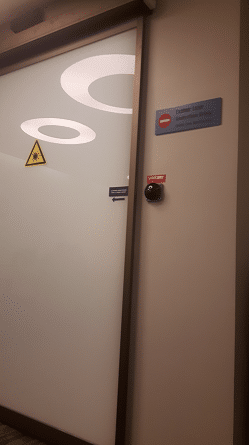
From there, I proceeded through the women’s changing area to the curtained cubicles containing the hospital beds and the usual measuring equipment. A security guard was called, who drew up a report for the valuables in my hospital bag, which I signed. My hospital bag was then locked away to prevent theft. I had to exchange my clothes for a disposable hospital gown, disposable underwear, and disposable slippers. Then I lay down on the bed. An anesthesiologist introduced himself before the first surgery, but I didn’t see him again. I was asked about my height, weight, previous surgeries, medications, etc. From then on, the interpreter left until after the surgery.
My blood pressure, pulse, and blood oxygen levels were measured. I had to give four vials of blood and had an IV line inserted, through which the sedative (not general anesthesia) for the surgery was later administered. I didn’t need a tranquilizer, as everything seemed so professional that I was the picture of calm. Three times, at longer intervals, a doctor came and numbed my eye with drops. This man was also present in the operating room. In between, I waited in my cubicle and observed the proceedings through the opening in the curtain.
After a while, two nurses came and, probably for safety reasons, guided me from the bed to a mobile chair that could be tilted into a lying position, taking me directly into the operating theatre. I did not notice when the sedation was administered. However, I did not feel any calmer than I already had been.
Afterwards, the area around the eye was disinfected and everything around the eye to be operated on was covered. At the instruction of Prof. Dr Banu Coşar, I had to fixate on a point past her ear so that she could place the clamp that kept the eye open. Then my eye looked into the light. It appeared like two bright rectangles standing next to each other, and everything around them seemed blue to me. Fascinating and beautiful.
I did not feel when the femtosecond laser incision was made or when the natural lens was fragmented. Only the rinsing procedures that took place in between felt cool. At a certain point, my eye even saw how the new lens was inserted and positioned. Whenever Prof. Dr Banu Coşar was not speaking with her colleagues in the operating theatre, she asked me in English how I was feeling and whether I was okay. Everything proceeded in a very relaxed manner.
At the end, a transparent plastic shield with holes was taped over the operated eye. I estimate that the actual operation took around 15 to 20 minutes.
Afterwards, I was wheeled back to my compartment and, due to the risk of falling, was again helped from the stretcher to the bed by orderlies. As in Switzerland, my circulation, pulse, and blood pressure were monitored again for a certain period. It was astonishing that my operated eye was soon able to see the pattern of the compartment curtain better through the eye patch and its holes than my unoperated -9.75 diopter eye. I experienced no pain at any time and was not given any painkillers. The only thing I noticed briefly while waiting was the sensation of an annoying eyelash in my eye. However, the sensation disappeared as suddenly as it had appeared.
There I met Prof. Dr. Banu Coşar again, who greeted me warmly and marked the eye to be operated on before we went through the “Excimer Laser” door. There, the interpreter gave me documents written in German, similar to those given in Switzerland for every outpatient hospital admission, which the interpreter and I signed after I had briefly read them through.
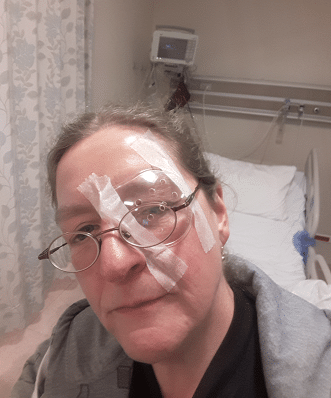
(Left eye, surgery on 20.02.2018)
Then a nurse brought me “breakfast”, which consisted of a drink, soup, stuffed eggplant, fruit, yogurt and bread.
The interpreter returned. My valuables were brought back to me, which I had to check and for which I had to sign the return form. I was allowed to get dressed. The doctor who had numbed my eye gave me two different bottles of eye drops and an eye ointment, along with instructions that from 6 p.m. onwards, I had to remove the eye patch from the top once an hour and apply the two different drops to my eye five minutes apart. Before going to sleep, I had to apply the ointment along the entire length of my lower eyelid. After that, I was not allowed to touch my eye until the follow-up appointment the next day.
I was driven back to the hotel. It took some getting used to putting my glasses for the unoperated eye over the eye patch. So I stayed nicely in the hotel room, dribbling my eye drops and rubbing them every hour, and slept perfectly well even with the eye patch on. Tip: Ask them to give you one of these on the day of your follow-up appointment, both for the hotel and for home.
February 21, 2018:
At 9:00 a.m., I was picked up for a follow-up examination at Acibadem Maslak Hospital. The interpreter took me back to the eye clinic. The doctor who had numbed my eye and given me the medication the previous day asked me in English how my eye was doing. He examined it and removed the eye patch from my eye, which was still stuck shut with ointment. Afterward, some more measurements were taken. Then I went back to Professor Dr. Banu Coşar’s consulting room.
Professor Banu Coşar examined my eye and performed a distance vision test. My distance vision was truly crystal clear with the operated eye, and I experienced no pain whatsoever. Professor Coşar explained that near vision could only be tested once both eyes had been operated on. She explained how to continue using the drops and ointment for the next four weeks. She gave me a sterile wipe to clean the ointment-covered eye and, when I asked, also provided me with a flyer for such wipes, which are available at pharmacies. She said that if I couldn’t find any, she could order them for me at the clinic. She also always gave me plenty of time and encouraged me to ask any questions I might have. Afterward, I was driven back to the hotel.
An optician at Acibadem Maslak Hospital removed the lens for my operated eye from my glasses free of charge, so I should have been able to see with both eyes. However, the glasses were somehow so bent that I saw double, and I couldn’t find anyone to adjust them. So, I left the glasses at the hotel and spent the rest of the day exploring historic Istanbul, first taking the M2 tram and then the M6 to the university campus. I was always alone, but even as a woman, I felt very safe in Istanbul. And Istanbul truly is a fascinating city, definitely worth a visit.
February 22, 2018:
Since the operated eye shouldn’t come into contact with water and soap, I used Thursday morning to find a hairdresser who would wash my long hair and cut it by 15 cm at the same time. I didn’t care that the hairdresser charged me an arm and a leg for his services, because it was still cheaper than in Switzerland.
At noon I was driven from the hotel back to Acibadem Maslak Hospital, where the same procedure as on the first day of surgery followed. The only difference was that I didn’t have to sign any more forms and no more blood was drawn.
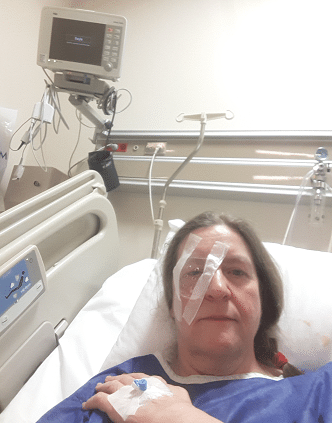
(Right eye, surgery on February 22, 2018; hospital outfit and breakfast. The left eye looks great!)
February 23, 2018:
At 10 a.m. I had to be ready at the hotel with my luggage and was driven to Acibadem Maslak Hospital for the final check-up.
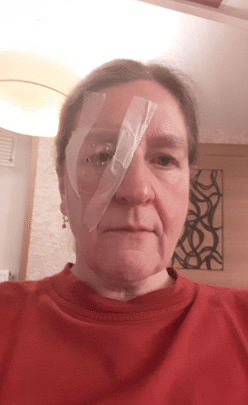
(Right eye before the final check of both operated eyes)
Professor Dr. Banu Coşar checked both eyes one last time and deemed the surgery a complete success. I could see clearly at a distance and also read text up close. She gave me another bottle of eye drops and another tube of eye ointment. Finally, she told me I could contact her again later if anything came up. She emphasized that with this type of surgery, my positive attitude would significantly contribute to the continued success of adjusting to my new way of seeing.
Afterwards, I was driven directly from the clinic to the airport with my luggage, along with other travelers, and had more than enough time to check in and go through passport control before my flight to Zurich at 4:30 pm.
After returning to Zurich, I allowed myself some vacation time. During this time, I practiced seeing with my new eyes using my laptop and reading books up close.
March 6, 2018:
I had my first follow-up appointment with the assigned ophthalmologist in the canton of Zurich. Beforehand, I was advised that I would be given pupil-dilating drops and that I should use public transportation to get to the practice. I was also told to bring sunglasses for afterward. The usual measurements were taken. During this initial examination, the doctor specifically checks whether the retina is properly positioned over the new lens. My eyes were undamaged and free of infection. With the dilated pupils, I already had 80% vision, and under normal circumstances, I would have 100%, the doctor said.
March 7, 2018:
Since March 7, 2018, I have been working without restrictions again. My eyes did need to get used to working at the computer in the first few days, but it has improved daily.
03. April 2018:
Second follow-up appointment with the doctor in Switzerland. It’s essentially the final examination. My distance vision is -0.25 diopters. I’m among the 80% who no longer need reading glasses after the surgery – I can’t drive, after all. I’m reserving two final consultations with the doctor in Switzerland until November 2018 and mid-February 2019 to check whether I’m also developing a secondary cataract. This condition often occurs after lens replacement and can be easily treated with laser surgery. If necessary, I can have this procedure done in Switzerland at the expense of my health insurance.
Finally:
Unlike laser eye surgery with its after-effects, lens replacement surgery is truly painless. However, you do have to get used to the new way of seeing and experience fluctuations in vision initially. These fluctuations haven’t affected me in my free time or at work (primarily computer work), and my vision with trifocal lenses is getting easier every day. I do see halos, but I hope my brain will adjust to them over the coming months. If not, I actually quite like the halos, and since I can’t drive, they don’t bother me when I’m cycling in the dark. A positive attitude is essential for a successful outcome.
I received excellent care and advice from SwissLasik throughout my treatment and felt very well looked after at Acibadem Maslak Hospital. Prof. Dr. Banu Coşar is a wonderful doctor with a truly trustworthy presence. Although I haven’t yet met Mr. Kara personally, he has my complete confidence. If the opportunity arises, I will gladly recommend SwissLasik.
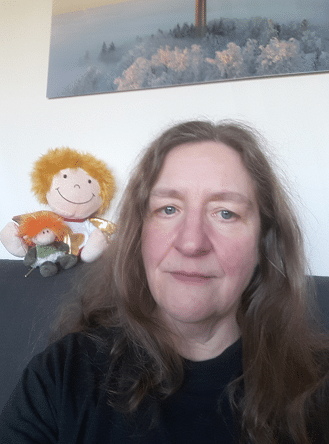
(Back home in Zurich with new eyes.)
Since the surgery, my quality of life has improved significantly, and I’m already looking forward to the start of the swimming season at my local pool. I would choose to have the procedure in Turkey again without hesitation and would make the trip with the support of SwissLasik. Thank you, Mr. Kara!
April 5, 2018 – Ursula Sahli, 8057 Zürich